


Mission-Critical Outdoor Positioning: Integrating Septentrio mosaic-X5 with Gateworks Edge Platforms
Outdoor autonomous systems require more than just accurate positioning, especially in mission-critical environments. In UAVs, defense applications and remote infrastructure systems, GNSS must continue operating under interference, degraded signals and dynamic conditions, while providing high data confidence.
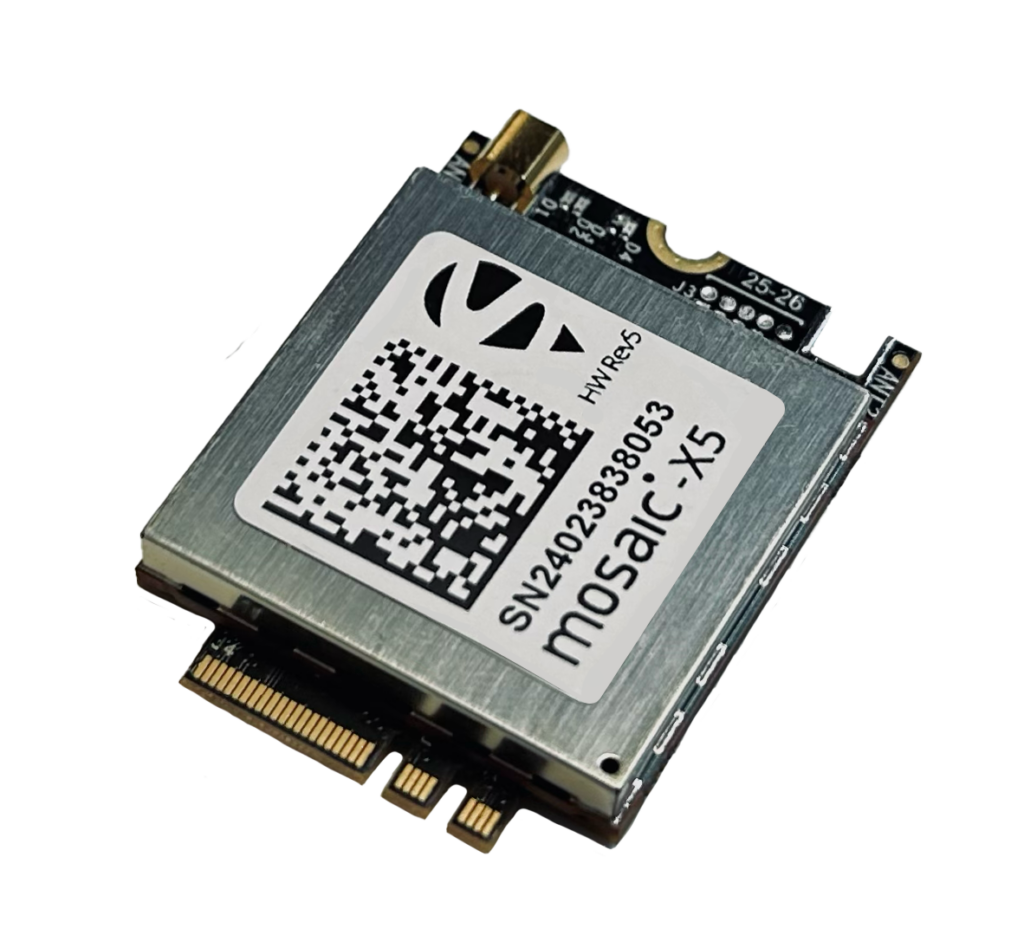
The Septentrio mosaic-X5 GNSS M.2 receiver module is designed for this class of problem. It combines multi-frequency GNSS tracking with interference mitigation, signal authentication and integrity monitoring. When integrated with Gateworks industrial single board computers, it enables a modular architecture for high-integrity positioning at the edge.
GNSS Performance Beyond Accuracy
The mosaic-X5 is a multi-band, multi-constellation receiver tracking GPS, Galileo, GLONASS, BeiDou and NavIC across multiple frequency bands. Multi-frequency operation improves positioning robustness and reduces susceptibility to ionospheric errors and signal degradation. It supports RTK positioning and update rates up to 100 Hz, allowing it to maintain low-latency tracking for dynamic systems such as UAVs and mobile platforms. These characteristics are essential for maintaining control fidelity in real-world environments.
Assured Positioning, Navigation and Timing (PNT): Anti-Jamming, Anti-Spoofing and Integrity
For defense and mission-critical systems, the key question is not just “how accurate is the position?” but “can the system trust it?”
The mosaic-X5 integrates Septentrio’s AIM+ (Advanced Interference Mitigation) technology, which actively detects and suppresses interference across both narrowband and wideband signals. This includes resilience against pulsed and complex jamming scenarios.
It also incorporates:
- Anti-spoofing and signal validation to detect anomalous GNSS behavior
- RAIM+ (Receiver Autonomous Integrity Monitoring) to assess positioning reliability
- APME+ (Advanced Multipath Mitigation) to reduce reflected signal errors
- LOCK+ for robustness under shock and vibration
- OSNMA (Open Service Navigation Message Authentication) supports signal authentication
These capabilities position the mosaic-X5 within the broader concept of assured PNT, maintaining reliable and trustworthy positioning in contested environments.
RTK Correction Services and Scalable Deployment
High-precision positioning depends on correction data. The mosaic-X5 supports standard methods such as NTRIP as well as satellite-delivered corrections.
Services like u-blox PointPerfect Flex GNSS correction service provide PPP-RTK corrections over IP or L-band, enabling centimeter-level positioning without requiring local base stations. This model simplifies deployment for distributed systems and mobile fleets.
For example:
- Cellular-connected systems can stream corrections via NTRIP
- Remote systems can use satellite-delivered corrections
- Private networks can deploy local base stations
This flexibility allows system designers to align correction strategies with operational constraints.
UAV and Defense System Relevance
Unmanned and defense systems operate in environments where GNSS degradation is expected, not exceptional. Positioning systems must maintain accuracy, continuity and integrity under these conditions. The GW16160 Mosaic x5 M.2 is industrial grade and engineered to perform in -40°C to +85°C temperatures and extreme environments.
The mosaic-X5 supports:
- Autonomous navigation and waypoint execution
- Geofencing and mission planning
- Mapping, inspection and situational awareness
It is also included in the Blue UAS Framework, a program led by the U.S. Department of Defense to identify trusted components for unmanned systems. This reflects both technical capability and supply chain trust, two critical requirements for defense deployments.
Practical Integration: GW16160 and Gateworks Platforms
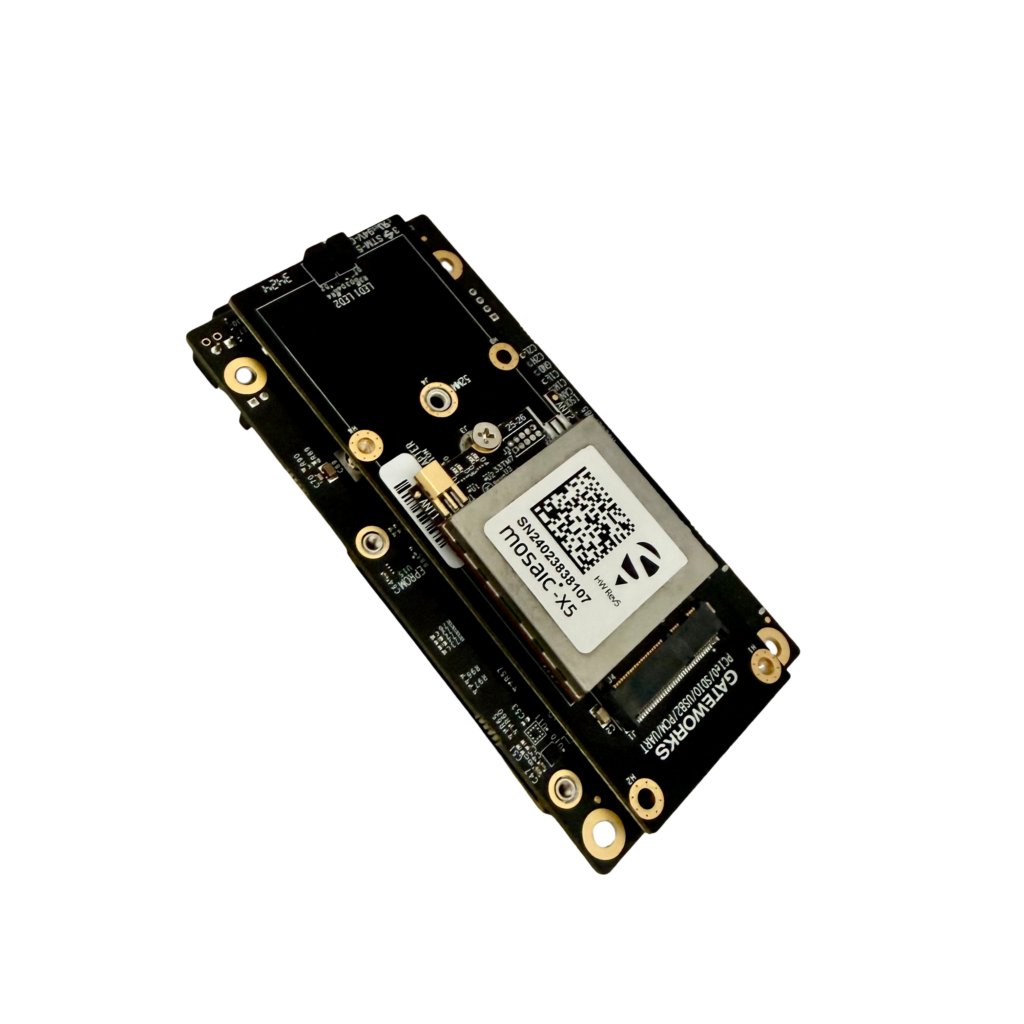
The Gateworks GW16160 GNSS M.2 module integrates the mosaic-X5 into a compact, deployable form factor. It provides a plug-and-play GNSS solution for Gateworks SBCs using a standard M.2 interface.
This reduces:
- Custom hardware design effort
- Integration complexity
- Time to deployment
GW16160 pictured with the GW8100 VeniceFLEX
The GW16160 is for use in autonomous systems, robotics, drones and outdoor asset tracking, where reliable GNSS is a foundational capability.
Gateworks platforms provide the compute and connectivity layer:
The NXP i.MX95 application processor enables AI-accelerated processing, advanced security and real-time system integration, supporting GNSS as one component within a broader autonomy stack.
Security, Traceability and Manufacturing Considerations
For defense and infrastructure deployments, hardware selection includes more than performance; it includes traceability, security and lifecycle control.
We design and manufacture all of our products in the United States, with a vertically integrated production process that emphasizes:
- Full component traceability
- Controlled manufacturing workflows
- Long lifecycle availability
Gateworks products are assembled, tested and tracked within a single facility, with serialized components and real-time process visibility. These factors support deployments where supply chain transparency and long-term support are required. https://www.gateworks.com/company/manufacturing/
System-Level Architecture
In practice, GNSS is one part of a larger system:
- GNSS receiver (mosaic-X5)
- Correction service (e.g., u-blox PointPerfect GNSS correction service, NTRIP, etc.)
- Embedded compute (Gateworks Venice, VeniceFLEX, Catalina)
- Connectivity (cellular, Wi-Fi HaLow, Wi-Fi)
This modular architecture allows systems to scale across deployment environments while maintaining positioning performance and system flexibility.
Conclusion
For mission-critical outdoor systems, GNSS must deliver more than accuracy; it must deliver resilience, integrity and trust.
The mosaic-X5 addresses these requirements through multi-frequency tracking, interference mitigation, anti-spoofing and integrity monitoring. Gateworks single board computers combined with the GW16160 module allow for a practical path to deploying high-integrity positioning within embedded edge systems.
This approach aligns with the needs of modern autonomous and defense systems, where positioning is not just an input but a trusted foundation for decision-making.
CONTACT US to get started with the Septentrio Mosaic-x5 M.2 Module.
Sources and Additional Reading:
Gateworks Corporation
Septentrio
NXP Semiconductors
- NXP i.MX GNSS Integration Discussions
- NXP i.MX95 Connected Edge Platform
- NXP i.MX95 Edge AI Overview
Where to Buy